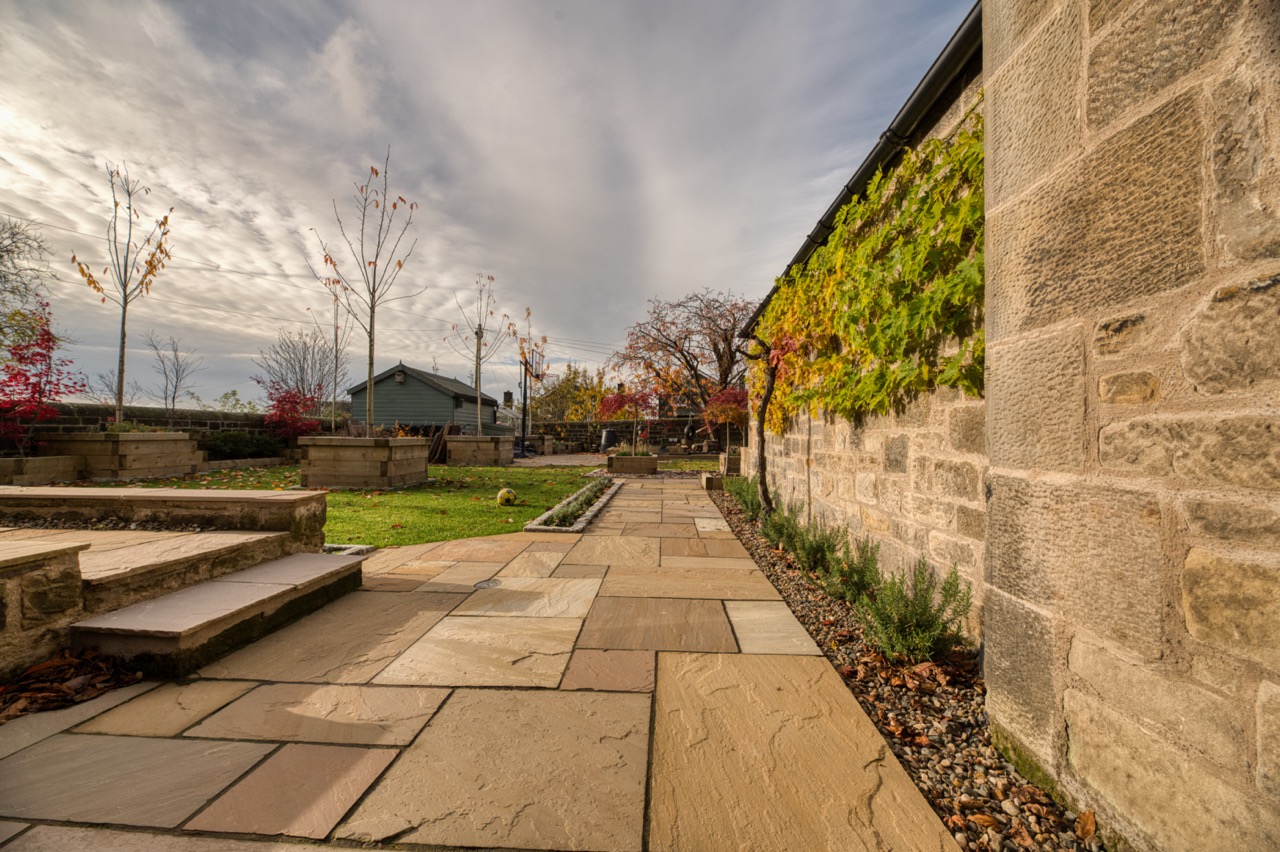
Buff Indian sandstone paving has become the gold standard for premium patio installations across Edinburgh, Stirling, Falkirk, and Central Scotland. This naturally beautiful stone combines timeless elegance with exceptional durability, making it the perfect choice for Scottish homeowners seeking a patio that enhances property value while withstanding our challenging climate. Whether you're transforming a garden in Livingston, creating an entertainment space in Dunfermline, or renovating a historic property in Edinburgh's conservation areas, buff sandstone delivers unmatched aesthetic appeal and practical performance.
With over 15 years of experience installing buff sandstone patios throughout Central Scotland, we've witnessed firsthand how this remarkable material transforms outdoor spaces. From compact courtyards in Linlithgow to expansive garden patios in Stirling, buff sandstone adapts beautifully to any setting. This comprehensive guide shares our professional insights on costs, installation techniques, maintenance requirements, and why buff sandstone remains our most recommended patio material for Scottish properties.
What is Buff Indian Sandstone?
Origin and Characteristics
Buff Indian sandstone is a natural sedimentary stone quarried from the Rajasthan region of India, formed over millions of years from compressed sand and minerals. The distinctive warm honey-cream tones result from iron oxide and feldspar content within the stone's composition. Each slab features unique natural variations in color and texture, ensuring no two patios look identical. The riven surface texture—created by splitting stone along natural fault lines—provides excellent slip resistance while showcasing the stone's authentic character.
Color Variations and Texture
Buff sandstone displays a harmonious palette of warm cream, honey gold, and subtle beige tones with occasional soft grey undertones. Unlike the dramatic color contrasts of raj green or autumn brown sandstone, buff offers gentle, consistent coloring that brightens outdoor spaces and complements both traditional and contemporary architecture. The natural riven finish provides textured grip underfoot while catching light beautifully throughout the day. Popular across Edinburgh's Georgian townhouses and Stirling's period properties, buff sandstone's neutral elegance ensures it never looks dated.
Why It Suits the Scottish Climate
Scottish weather demands paving materials that withstand freeze-thaw cycles, heavy rainfall, and temperature fluctuations—buff sandstone excels in all conditions. The stone's dense composition and low porosity prevent water absorption that causes cracking during winter freezes, a critical advantage over materials like concrete or cheaper imported stone. Across Falkirk, Bathgate, and West Lothian, our buff sandstone installations have performed flawlessly through harsh winters. The naturally textured surface maintains grip even when wet, crucial for safety during Edinburgh's frequent rain. The stone's ability to shed water quickly prevents moss and algae buildup common with smoother surfaces.
Benefits of Buff Sandstone Paving
Durability and Longevity
Professionally installed buff sandstone patios last 25-50+ years with minimal maintenance, representing exceptional long-term value. Unlike porcelain or concrete that can crack, chip, or degrade, natural sandstone becomes more attractive with age, developing an elegant weathered patina. We've maintained installations from the 1990s across Edinburgh and Stirling that still look superb. The 22mm calibrated thickness handles pedestrian traffic and garden furniture effortlessly. When paired with proper sub-base preparation—our standard 150mm Type 1 stone base—buff sandstone provides a lifetime patio solution that often outlasts the properties they serve.
Aesthetic Appeal
Buff sandstone's warm, inviting tones create visual harmony with Scottish landscapes and architecture. The gentle cream-honey coloring brightens gardens, makes small spaces feel larger, and provides an elegant backdrop for planting schemes. Whether you're creating a traditional cottage garden in Alloa or a contemporary entertaining space in South Queensferry, buff sandstone adapts seamlessly. The natural variations in each slab prevent monotony while maintaining overall coherence. Property owners in Kirkcaldy and Cowdenbeath consistently report that buff sandstone patios significantly enhance curb appeal and property values, with estate agents noting it as a strong selling feature.
Slip Resistance and Safety
Safety is paramount in Scotland's wet climate, and buff sandstone delivers with its naturally riven texture providing R11 slip rating—significantly safer than smooth porcelain, polished granite, or standard concrete. The textured surface maintains grip even during Edinburgh's wettest months, making it ideal for families with children, elderly residents, or pool surrounds. Unlike artificially textured materials that can wear smooth, sandstone's natural profile remains consistent throughout its life. For Livingston and Linlithgow properties with slopes or challenging access areas, the reliable traction provides year-round confidence.
Value for Money
While initial costs exceed basic concrete or budget slabs, buff sandstone offers superior long-term value. Factor in 30+ year lifespan, minimal maintenance requirements, enhanced property values, and timeless aesthetic appeal—the per-year cost becomes remarkably economical. Across Falkirk, Grangemouth, and Bo'ness, homeowners appreciate that quality sandstone patios require no replacement during property ownership. The investment protects against repeated renovation costs associated with cheaper materials that crack, fade, or require frequent replacement. Our 10-year installation guarantee further protects your investment.
Low Maintenance Requirements
Buff sandstone requires minimal upkeep compared to alternatives. Simple sweeping and occasional washing with pH-neutral cleaner maintains appearance. Sealing every 2-3 years enhances protection and color depth but isn't essential. Unlike composite decking requiring annual treatment, or block paving needing regular re-sanding and weed removal, sandstone stays beautiful with minimal intervention. For busy Edinburgh professionals and families across Stirling and Dunfermline, this low-maintenance characteristic proves invaluable. The stone's natural resistance to staining, fading, and weather damage means your patio looks superb year after year without constant attention.
Cost Guide for Edinburgh & Central Belt
Understanding buff sandstone paving costs helps budget effectively for your Edinburgh or Central Scotland project. Material costs range £40-£65 per square metre depending on quality grade, supplier, and quantity ordered. Installation costs vary £80-£120 per square metre based on site complexity, access, existing surface removal, and sub-base requirements. A typical 30m² patio therefore costs £3,600-£5,550 complete including materials, professional installation, proper drainage, and our 10-year guarantee.
Regional variations affect pricing across our service area. Edinburgh projects sometimes carry premium costs due to access challenges and material transport to city locations. Stirling, Falkirk, and rural areas like Linlithgow or Bathgate often benefit from easier access and lower transportation costs. Large projects (50m²+) achieve better per-square-metre rates. Additional costs include excavation if removing existing patios (£15-£25/m²), complex drainage solutions for problematic sites (£500-£1,500), and bespoke features like circles or steps.
Size considerations significantly impact value. Smaller patios (15-20m²) have higher per-square-metre costs due to minimum mobilization charges and material wastage. Medium patios (30-40m²) offer optimal value. Large installations (50m²+) across properties in Dunfermline, Musselburgh, or Tranent achieve the most economical rates. We provide detailed, itemized quotes showing exactly what's included, ensuring no hidden costs surprise homeowners in Bonnyrigg, Whitburn, or Broxburn.
Long-term value comparison reveals buff sandstone's superiority. While initial investment exceeds budget alternatives, the 30+ year lifespan, minimal maintenance costs (£50-£100 annually for sealing products), zero replacement expenses, and enhanced property value (typical £3,000-£8,000 increase) deliver exceptional return on investment that budget materials simply cannot match.
Professional Installation Process
Site Preparation
Professional installation begins with thorough site assessment and preparation. We excavate to appropriate depth (typically 250-300mm for patios), accounting for finished levels relative to damp proof courses and doorway thresholds. For Edinburgh and Stirling properties with existing patios, we remove old surfaces, disposing of waste responsibly. The excavation gradient ensures proper water runoff (minimum 1:60 fall away from properties). We address drainage issues common in Scottish clay soils, installing land drains where necessary to prevent water pooling beneath the patio.
Sub-Base Construction
The sub-base determines patio longevity—we never compromise here. Our standard specification uses 150mm compacted Type 1 MOT stone (40% thicker than minimum requirements) to handle Scottish soil conditions and prevent settlement. For challenging sites in Livingston, Falkirk, or areas with poor drainage, we increase to 200mm depth. The stone is laid in 75mm layers, each thoroughly compacted using vibrating plates to achieve 95%+ compaction. This creates a stable, permeable foundation that sheds water effectively, crucial in Scotland's wet climate.
Laying Technique
Buff sandstone slabs are laid on a full 40-50mm mortar bed (6:1 sharp sand to cement ratio) ensuring complete support and preventing voids that cause cracking. We use string lines and laser levels achieving perfectly level surfaces or specified gradients. Each slab is carefully positioned, tapped into place, and checked for level in multiple directions. Joint widths remain consistent at 10-15mm for optimal appearance. For Dunfermline and Kirkcaldy projects, we pre-plan layouts minimizing cuts and ensuring attractive patterns whether using single sizes or mixed project packs.
Pointing and Sealing
After 48-72 hours allowing mortar beds to cure, we point joints using appropriate materials—typically easy-point mortar or traditional mortar carefully applied and finished flush or slightly recessed. Pointing prevents weed growth and water ingress while complementing the stone's natural color. Once pointing cures (7-10 days), we thoroughly clean the surface and apply breathable sealant that enhances color, protects against staining, and simplifies maintenance. The sealant allows moisture vapor transmission while repelling water—essential for Scotland's climate.
Timeline Expectations
Typical timeline for 30m² buff sandstone patio: site preparation and sub-base installation (1-2 days), mortar bed preparation and slab laying (2-3 days), curing period (2-3 days), pointing (1 day), final curing and sealing (1 day). Total project duration: 7-12 days weather dependent. Larger projects across Edinburgh, Stirling, or Falkirk estates require proportionally longer. Scottish weather impacts scheduling—we avoid laying during heavy rain or freezing conditions ensuring quality results. We provide realistic schedules considering seasonal factors affecting projects in Alloa, Bo'ness, Grangemouth, and throughout Central Scotland.
Maintenance Guide for Scottish Conditions
Regular Cleaning Routine
Maintaining buff sandstone beauty requires minimal effort. Sweep regularly removing leaves, dirt, and debris that can stain if left decomposing on the surface. Wash with warm water and pH-neutral stone cleaner 2-3 times yearly—spring, mid-summer, and autumn cleanings prevent buildup. Avoid pressure washers above 1500 PSI as excessive force damages pointing and can erode stone surface. For Edinburgh and Stirling gardens with trees, more frequent sweeping prevents tannin staining from fallen leaves, particularly important during autumn months.
Sealing Recommendations
Apply breathable, natural-look sealant every 2-3 years maintaining protection and enhancing appearance. Quality sealers (£50-£100 for typical patios) prevent staining from organic matter, simplify cleaning, and deepen the stone's natural color. Apply during dry weather with temperatures above 10°C—typically May-September across Central Scotland. The sealant should be absorbed within 30 minutes; excess should be removed preventing glossy patches. For shaded areas in Livingston, Linlithgow, or wooded properties in Bathgate, annual sealing provides better protection against moisture-loving moss and algae.
Winter Care
Buff sandstone handles Scottish winters excellently with minimal intervention. Avoid de-icing salts that can damage natural stone—use sand for grip instead. Remove snow using plastic shovels preventing surface scratching. Allow ice to melt naturally when possible; if intervention needed, use hot water rather than chemicals. The stone's natural frost resistance means no special protection required. Across Falkirk, Stirling, and Edinburgh, our installations withstand harsh winters without deterioration. Ensure drainage remains clear preventing water pooling that could freeze against building walls.
Best Applications for Buff Sandstone
Buff sandstone excels in various applications across Edinburgh and Central Scotland properties. Large patio areas benefit from the stone's ability to create cohesive, elegant entertaining spaces that complement both traditional and contemporary architecture. Garden pathways in Dunfermline, Kirkcaldy, and Cowdenbeath look stunning edged with planting, the warm tones enhancing greenery. Courtyard areas in Edinburgh's New Town or Stirling's conservation areas suit buff sandstone perfectly, the refined appearance respecting period character.
The material pairs beautifully with features like pergolas, raised beds, water features, and outdoor kitchens. For Livingston and South Queensferry properties with pool areas, the slip-resistant surface provides safety while creating resort-like ambiance. Terraced gardens across Musselburgh, Tranent, and Bonnyrigg utilize buff sandstone for consistent aesthetic flow between levels. The stone's versatility suits Georgian townhouses, Victorian villas, modern new-builds, and rural cottages throughout Linlithgow, Bathgate, Whitburn, Broxburn, Alloa, Bo'ness, and Grangemouth.
Why Choose Maybury Landscaping for Your Buff Sandstone Patio
Our 15+ years specializing in natural stone installations across Edinburgh, Stirling, Falkirk, and Central Scotland ensures your patio receives expert attention throughout every stage. We've installed hundreds of buff sandstone patios, understanding exactly how this material performs in Scottish conditions and which installation techniques deliver optimal longevity. Our team sources premium-grade sandstone directly from trusted suppliers, ensuring consistent quality and competitive pricing for projects throughout our service area.
We provide comprehensive 10-year workmanship guarantees protecting your investment. Our installation standards exceed industry requirements—40% thicker sub-bases, full mortar beds, proper drainage integration, and meticulous attention to levels and finishes. From initial consultation through project completion and aftercare advice, we're committed to exceeding expectations. Serving homeowners in Edinburgh, Stirling, Falkirk, Livingston, Linlithgow, Bathgate, Dunfermline, Kirkcaldy, Alloa, South Queensferry, Musselburgh, Tranent, Bonnyrigg, Cowdenbeath, Whitburn, Broxburn, Bo'ness, Grangemouth, and throughout Central Scotland, we're your local experts in premium buff sandstone paving.
Frequently Asked Questions
Ready to Transform Your Garden with Buff Sandstone?
Get your free, no-obligation quote today. Our expert team will visit your property in Edinburgh, Stirling, Falkirk, or anywhere across Central Scotland to discuss your vision, provide professional recommendations, and deliver a detailed quotation. No pressure, just honest advice from experienced landscaping specialists.