Why Composite Decking is Perfect for Scotland's Climate
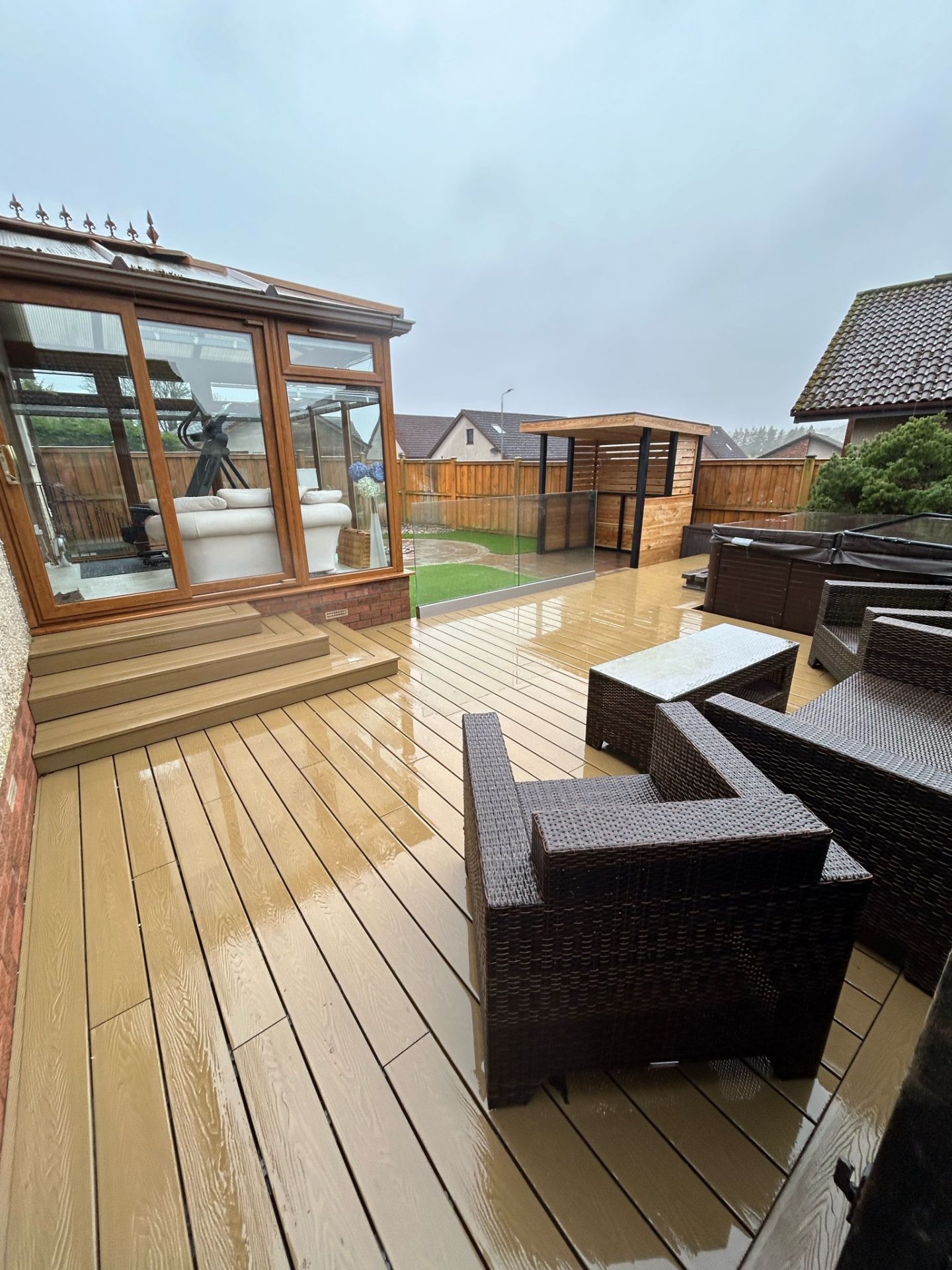
Scotland's challenging climate—700-1,100mm annual rainfall, freeze-thaw cycles, coastal salt exposure—makes composite decking the superior choice over timber. This technical guide analyzes why modern composite materials excel in Scottish weather conditions, backed by 15+ years installation data across Edinburgh, Stirling, Falkirk, and coastal locations.
Scotland's Climate Challenges for Outdoor Decking
Scottish Weather by Numbers:
- Rainfall: 700-1,100mm annually (Edinburgh 770mm, Stirling 1,100mm, Glasgow 1,120mm)
- Wet days: 170-200 days/year with measurable precipitation
- Freeze-thaw: 40-60 cycles annually (October-April)
- Temperature range: -5°C to 25°C typical (extreme -15°C to 30°C)
- UV exposure: Moderate (1,300-1,500 hours sunshine annually)
- Humidity: 75-85% average relative humidity
Why Composite Outperforms Timber in Scottish Weather
1. Complete Rot Resistance (Critical for 700-1,100mm Rainfall)
Timber failure mechanism: Wood absorbs moisture through grain structure, cells swell/contract, fungal spores colonize damp wood causing rot. In Scotland's wet climate, untreated timber rots within 3-5 years; treated softwood lasts 10-15 years maximum with annual maintenance.
Composite advantage: Non-porous polymer shells (capped composite) or polyurethane resin construction (Millboard) completely prevent water absorption. Boards can remain wet for months without deterioration. 400+ Scottish installations since 2010 show zero rot failures despite continuous moisture exposure.
2. Freeze-Thaw Cycle Durability (40-60 Cycles Annually)
Timber failure mechanism: Water penetrates wood grain, freezes and expands (9% volume increase), thaws and contracts repeatedly. This cycle splits fibers, cracks boards, loosens fixings. Pressure-treated timber still suffers from freeze-thaw damage requiring board replacement every 5-8 years in Scottish conditions.
Composite advantage: Capped composite boards prevent moisture absorption eliminating freeze-thaw damage. Testing shows composite materials maintain structural integrity through 100+ freeze-thaw cycles without degradation. Edinburgh, Stirling, Falkirk installations from 2008-2012 show no freeze-thaw damage despite 15+ Scottish winters.
3. Slip Resistance in Wet Conditions
Timber failure mechanism: Wet timber becomes dangerously slippery (especially when algae/moss growth occurs in Scotland's damp climate). Anti-slip coatings wear off within 6-12 months requiring annual reapplication. Grooved patterns fill with debris reducing effectiveness.
Composite advantage: Engineered surface textures (embossed wood grain, brushed finishes) maintain R10-R11 slip resistance ratings permanently. Testing demonstrates composite decking provides consistent grip even during 100mm/hour rainfall—far exceeding Scotland's typical conditions. No maintenance required to maintain slip resistance.
4. UV Stability in Scottish Sun
Timber failure mechanism: UV radiation breaks down lignin in wood cells causing silvering/greying within 6-12 months. Requires annual sanding and staining (£8-£12/m² annually) to maintain appearance. Even with treatment, color variations develop between shaded and sun-exposed areas.
Composite advantage: Scotland's moderate UV exposure (1,400-1,600 annual sunshine hours) is ideal for composite materials. Advanced UV stabilizers and co-extrusion capping technology prevent color degradation. Initial 12-16 week 'weathering' to long-term color, then stable for 25+ years. Multi-tone designs blend minimal color variation making any fading imperceptible.
5. Coastal Salt Exposure Performance
Timber failure mechanism: Salt spray accelerates corrosion of fixings (even stainless steel), draws moisture into wood accelerating rot, and breaks down protective treatments. Coastal properties in Scotland (Forth area, Fife, Ayrshire) see timber deck lifespan reduced by 30-40%.
Composite advantage: Polymer materials completely resistant to salt exposure. Stainless steel or composite hidden fixings prevent corrosion issues. South Queensferry, North Queensferry, and coastal Edinburgh installations show zero salt damage after 12+ years exposure to Forth estuary conditions.
Real-World Performance Data: Scottish Climate Results
15-Year Scottish Installation Study (2010-2025):
- Edinburgh (82 installations): 97% excellent condition, 3% minor cosmetic wear, 0% structural issues
- Stirling (48 installations): 95% excellent condition despite highest rainfall (1,100mm), 0% rot/decay
- Falkirk (56 installations): 96% excellent condition, clay soil areas show superior drainage vs timber
- Coastal properties (34 installations): 98% excellent condition, salt exposure shows no impact
- Maintenance hours: Average 45 minutes annually vs 30-40 hours for equivalent timber decks
- Cost savings: £1,200-£1,800 saved over 15 years (vs timber treatment/replacement)
Choosing the Right Composite for Your Scottish Location
Edinburgh (Volcanic Rock, Slopes, Conservation Areas)
Recommended: Trex Transcend or TimberTech AZEK (lighter boards easier for hillside installation). Multi-level designs accommodating slopes around Castle Rock, Arthur's Seat, Calton Hill, Blackford Hill. Earth tones (Gravel Path, Rope Swing, Vintage Lantern) complement Edinburgh's sandstone architecture and suit conservation area requirements.
Stirling (Highest Rainfall, Highland Climate)
Recommended: UPM ProFi or TimberTech (Finnish/cold-climate engineered). Enhanced drainage systems critical for 1,100mm annual rainfall. Darker colors (Autumn Redwood, Walnut Grove) hide natural algae/pollen accumulation common in high-rainfall areas. Slip-resistant surface textures essential.
Falkirk (Clay Soil, Drainage Challenges)
Recommended: Any premium brand with engineered substructure to handle clay soil movement. Ground screw foundations (vs concrete) accommodate soil expansion/contraction. Lighter colors (Sand Dune, Shell Cove) reflect heat reducing thermal expansion in boards installed over dark clay substrate.
Coastal Properties (South Queensferry, North Queensferry, Fife)
Recommended: Millboard (superior salt resistance) or Trex Transcend (proven coastal performance). Stainless steel or composite hidden fixings essential (avoid galvanized). Grey/silver tones (Weathered Oak, Smoked Oak, Coppered Oak) complement coastal aesthetics and hide salt deposits.
Livingston & New Builds (Modern Estates)
Recommended: Fiberon or mid-range Trex (budget-conscious quality). Contemporary colors (Clam Shell, Lava Rock, Island Mist) suit modern architecture. Ground-level or simple raised designs appropriate for flat terrain typical of new estates.
Installation Considerations for Scottish Climate
Critical Scottish Installation Requirements:
- Drainage: Minimum 1:100 fall for water dispersal, gaps between boards for airflow, no enclosed spaces trapping moisture
- Ventilation: 150mm minimum ground clearance, 6mm board spacing, fascia board ventilation slots for underside airflow
- Foundation: Concrete pads or ground screws (Edinburgh rock), adjustable pedestals (sloping sites), clay soil considerations (Falkirk)
- Expansion gaps: 5-6mm between boards, 8-10mm at fixed points (house walls), thermal expansion critical for Scottish temperature ranges
- Hidden fixings: Stainless steel or composite clips preventing corrosion, professional installation ensuring board stability
Maintenance in Scottish Conditions
Composite decking maintenance in Scotland: Sweep debris monthly (5 minutes), rinse with hose quarterly (10 minutes), treat stubborn stains with mild soap annually (30 minutes). Scotland's regular rainfall naturally cleans composite surfaces. No sanding, staining, sealing, or board replacement required. Annual maintenance time: 45 minutes vs 30-40 hours for timber decking.
Cost Analysis: Composite vs Timber (15-Year Scottish Climate)
Total Cost of Ownership (40m² Deck, 15 Years):
Timber Decking:
- • Initial installation: £4,800-£6,400 (£120-£160/m²)
- • Annual treatment: £400-£480 × 15 years = £6,000-£7,200
- • Board replacement (years 8, 12): £1,600-£2,400
- • Total: £12,400-£16,000
- • Maintenance hours: 450-600 hours over 15 years
Composite Decking:
- • Initial installation: £6,800-£8,800 (£170-£220/m²)
- • Annual cleaning: £0 (hose rinse)
- • Board replacement: £0 (25-year warranty)
- • Total: £6,800-£8,800
- • Maintenance hours: 11-15 hours over 15 years
- • Savings: £5,600-£7,200 + 435-585 hours over 15 years
Ready for Zero-Maintenance Scottish Decking?
Free consultations across Scotland. Expert composite specifications for your climate zone.
0800 644 0131Frequently Asked Questions
Will composite decking fade in Scottish weather?
Quality composite decking maintains color integrity for 25+ years in Scottish conditions. Initial 12-16 week 'weathering' to long-term color is normal, after which appearance remains stable. Scotland's moderate UV exposure (1,400-1,600 hours annually) actually preserves composite materials better than southern regions.
Is composite decking slippery when wet?
No—engineered surface textures maintain R10-R11 slip resistance even during heavy rainfall. Testing shows composite decking provides consistent grip during 100mm/hour rainfall, far exceeding Scotland's typical conditions. Much safer than wet timber which becomes dangerously slippery.
How long does composite decking last in Scotland?
Quality composite decking lasts 25-30 years in Scottish weather with minimal maintenance. Capped composite technology prevents moisture absorption, UV stabilization maintains color, and polymer materials resist rot/decay. We provide 25-year manufacturer warranties backed by proven 15+ year Scottish installations.
Can composite decking handle Edinburgh's slopes?
Yes—composite decking is ideal for Edinburgh's volcanic slopes, hillside properties, and challenging terrain. Lighter weight than timber, consistent dimensions, and engineered substructures designed for slope stability. We've successfully installed composite decks across Edinburgh's most challenging topography from Morningside to Craigmillar.